In Part 1, we established why a voltage-mode buck converter needs a compensator: the LC output filter drives the plant phase to -158° at any practical crossover frequency, leaving only 22° of phase margin. The compensator's zeros recover that phase. The integrator eliminates the DC regulation error. The high-frequency poles roll off gain above crossover.
This article turns those concepts into component values. Starting from the design targets set in Part 1, I'll walk through every calculation, round to standard values, and verify the result. It is a Type III throughout. If you have not settled on that yet, Compensator Types covers how the choice is made.
Design targets (from Part 1)
24V input, 5V output, 100W, voltage-mode buck at 150 kHz. The plant parameters:
- = 4.95 kHz (L = 4.7 µH, C = 220 µF)
- = 145 kHz (ESR = 5 mΩ)
- Plant gain at 15 kHz: 3.1 dB
- Plant phase at 15 kHz: -158°
The compensator targets:
- Crossover frequency: 15 kHz ()
- Phase margin: ≥ 55°
- Two zeros near to boost phase at crossover
- Two high-frequency poles to roll off gain: one at (75 kHz), one at (145 kHz)
The Type III circuit
Fig. 6 shows the compensator circuit [1]. It's an inverting op-amp configuration with six passive components forming the frequency-shaping network: three resistors (, , ) and three capacitors (, , ).
The input impedance consists of in parallel with in series. The feedback impedance consists of in parallel with in series. The transfer function is:
This gives three poles and two zeros:
| Feature | Frequency | Components |
|---|---|---|
| Zero 1 | , | |
| Zero 2 | , , | |
| Pole 1 | , , | |
| Pole 2 | , | |
| Integrator | , , |
Notice that the second zero and second pole share the same components (, ) but differ by whether is included. Since in most designs, . The ratio is set by the resistance ratio alone.

Design procedure
The circuit has six components and five constraints (two zeros, two poles, and the crossover gain) leaving one free parameter. The standard approach [2][3] is to fix and derive everything else.
Step 1: Choose
sets the input impedance of the compensator. For most designs, 1 kΩ to 100 kΩ is practical. Lower values will reduce noise sensitivity and higher values will reduce power consumption in the feedback divider.
Step 2: Set the zero and pole frequencies
From Part 1, the compensator needs a net phase of about +38° at crossover to achieve 60° PM. That is 128° above the integrator's -90°. With two poles at 75 kHz and 145 kHz contributing -11° and -6° respectively at 15 kHz, the two zeros must provide approximately +145° combined.
The targets:
The zeros are placed either side of (4.95 kHz), one below the resonance and one above it. This provides maximum phase boost through the crossover region.
Step 3: Compute (from the zero/pole ratio)
The second zero and second pole share , so their ratio gives directly:
Rearranging:
Step 4: Compute (second pole)
Verify : . Correct.
Step 5: Compute and (first zero, first pole, and crossover gain)
The first zero and first pole are both set by , , and :
Dividing by eliminates :
Rearranging gives in terms of :
This leaves as the only unknown. It's determined by the gain constraint: at crossover, .
Writing the compensator magnitude at crossover and substituting :
where , and similarly for the other time constants. Setting and solving for :
Evaluating the magnitude terms at 15 kHz: (the zero at 3.2 kHz is well below crossover, so this term is large), , and the pole terms are both close to unity (1.02 and 1.01, since the poles are well above crossover). The plant gain .
With rad/s:
Then :
Step 6: Compute (first zero)
Summary of exact values
| Component | Value | Role |
|---|---|---|
| 10 kΩ | Input impedance (chosen) | |
| 2.83 kΩ | First zero, first pole | |
| 447 Ω | Second zero, second pole | |
| 17.6 nF | First zero, gain | |
| 784 pF | First pole | |
| 2,456 pF | Second zero, second pole |
Rounding to standard values
Real components come in discrete values. The nearest E96 resistors and E12 capacitors:
| Component | Exact | Standard | Shift |
|---|---|---|---|
| 10.00 kΩ | 10 kΩ | 0% | |
| 2.83 kΩ | 2.80 kΩ | -1.1% | |
| 447 Ω | 442 Ω | -1.1% | |
| 17.6 nF | 18 nF | +2.3% | |
| 784 pF | 820 pF | +4.6% | |
| 2,456 pF | 2.7 nF | +9.9% |
has the largest rounding error because the exact value (2,456 pF) falls between the E12 values of 2,200 pF and 2,700 pF. The 2,700 pF choice shifts from 6,200 Hz to 5,645 Hz and from 145 kHz to 133 kHz. Both zeros move slightly lower, which adds a small amount of extra phase at crossover.
With standard values, the actual pole and zero locations:
| Parameter | Target | Actual | Shift |
|---|---|---|---|
| 3,200 Hz | 3,158 Hz | -1.3% | |
| 6,200 Hz | 5,645 Hz | -9.0% | |
| 75,000 Hz | 72,476 Hz | -3.4% | |
| 145,000 Hz | 133,363 Hz | -8.0% |
The crossover frequency shifts from 15.0 kHz to 15.9 kHz. The phase margin changes from 60.0° to 61.0°. A one-degree improvement from component rounding, but don't count on that. Here the errors pulled against each other. The second zero fell 9%, which adds phase at crossover, and that outweighed the poles falling 3–8%. If the rounding had pushed the zeros up and the poles down, the same exercise would have cost margin.
Verification
Fig. 7 shows the final loop gain Bode plot using the standard component values. The compensator gain (green) rises at +20 dB/decade from the integrator, flattens through the zero region where it provides phase boost, then falls above the poles at 72 kHz and 133 kHz. The resulting loop gain (navy) crosses 0 dB at 16 kHz with 61° of phase margin.
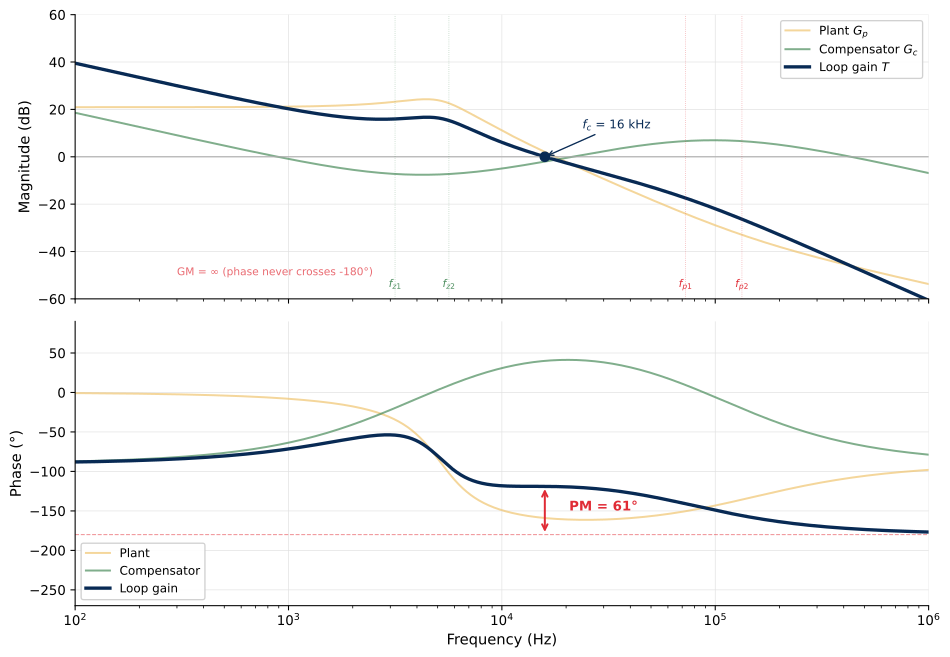
The loop phase never reaches -180°, giving infinite gain margin in the averaged model. The loop gain is well below 0 dB at 150 kHz, providing adequate attenuation of switching ripple.
What comes next
The design procedure above assumes nominal component values. Part 3 propagates worst-case tolerances through the compensator. What happens to phase margin when the output capacitance drops 40% from DC bias derating, the inductor shifts 20% from current derating, and the ESR drifts with temperature? That's where the difference between 60° at nominal and 60° at worst case becomes real.
Checking the six values above at one operating point is quick. Checking them at every tolerance corner, each time a part changes, is what switchmode.io is being built to do.
References
[1] Texas Instruments, "Demystifying Type II and Type III Compensators Using Op-Amp and OTA for DC/DC Converters," Application Report SLVA662, Jul. 2014. [Online]. Available: https://www.ti.com/lit/an/slva662/slva662.pdf
[2] H. D. Venable, "The K factor: A new mathematical tool for stability analysis and synthesis," Proc. Powercon 10, San Diego, CA, 1983. [Online]. Available: https://www.venableinstruments.com/hubfs/The%20K%20Factor%20a%20New%20Mathematical%20Tool%20for%20Stability%20Analysis.pdf
[3] C. Basso, Designing Control Loops for Linear and Switching Power Supplies, Artech House, 2012.