A practical comparison of impedance-based stability criteria, from most conservative to least, and what each one costs your design.
Add an input filter to a working converter and the output starts oscillating. The Bode plot still shows 45° phase margin on the main control loop, the output capacitors are fine, the compensation network hasn't changed, the oscillation is at 16kHz, not at the loop crossover, and it's only present above 60% load. Disconnect the input filter and it stops.
If you've seen this, you've discovered that a regulated converter looks like a negative resistance to its input supply [1]. The input filter's LC resonance can interact with that negative resistance and turn a stable converter into an oscillator, even though neither the filter nor the converter has any problem on its own. The standard solution is Middlebrook's criterion [1]: keep the source impedance below the load impedance at all frequencies, and the interaction can't happen.
The problem with Middlebrook is that it can be too conservative. It uses magnitude only and ignores phase [6], [8]. A design that violates it by 3dB can be perfectly stable if the phase relationship at the overlap frequencies keeps the system away from the instability condition. The result is that engineers following Middlebrook end up adding damping networks, oversized bus capacitors, or detuned filters that waste board space and degrade transient response to fix a problem that doesn't exist.
This article walks through seven stability criteria applied to the same converter and input filter. Each criteria is different, demanding different level of conservatism, with some needing a filter redesign and others confirming the original design is fine. The full Nyquist analysis settles the argument.
Why your converter looks like a negative resistance
A regulated buck converter holds its output voltage constant. If the input voltage drops by 1V, the duty cycle increases to compensate, and the input current rises to maintain the same output power. From the input supply's perspective, lower voltage caused higher current causing a negative incremental resistance [1], [10].
The magnitude is:
For a 48V-to-5V converter delivering 40A (200W), = -48²/200 = -11.5Ω. If you connect a frequency response analyser to the converter's input and inject a small AC perturbation at frequencies below the control loop bandwidth, you'll measure a negative real impedance that sits at roughly -11.5Ω [12].
Above the control loop bandwidth, the converter can't respond fast enough to regulate, and its input impedance transitions to the passive impedance of the input capacitors and power stage. The negative resistance exists only in the frequency range where the control loop is active.
This matters because an LC input filter has a resonant peak in its output impedance. If that peak falls near the frequency range where the converter's input impedance is negative, the combination can form a negative-resistance oscillator. The frequency of oscillation is the filter's resonant frequency, not the converter's loop crossover, which is why it looks like a completely unrelated failure mode when you first see it on the bench.
The minor loop gain: one ratio that determines everything
Every impedance-based stability criterion starts from the same point [6]. A source subsystem with output impedance feeds a load subsystem with input impedance . The voltage transfer function of the interconnected system contains the factor:
is the minor loop gain. By the Nyquist criterion, the system is stable if and only if the Nyquist plot of doesn't encircle the point (-1, 0) in the complex plane, provided both subsystems are individually stable [6].
Every simplified stability criterion defines a "forbidden region" in the complex plane that the Nyquist plot must avoid. The forbidden region always contains (-1, 0) but extends further to provide design margin. The larger the region, the more conservative the criterion and the bigger the input filter needs to be.
The worked example
The reference design throughout this article is a 48V-to-5V, 200W synchronous buck converter with a voltage-mode control loop crossing over at 10kHz. An LC input filter is added for conducted EMI compliance:
- = 4.7µH, DCR = 20mΩ
- = 22µF ceramic (X7R, ESR = 5mΩ)
- Filter resonance: 15.7kHz
- Characteristic impedance: = 0.46Ω
- Q factor: ~18 (low damping from good ceramic caps and a low-DCR inductor)
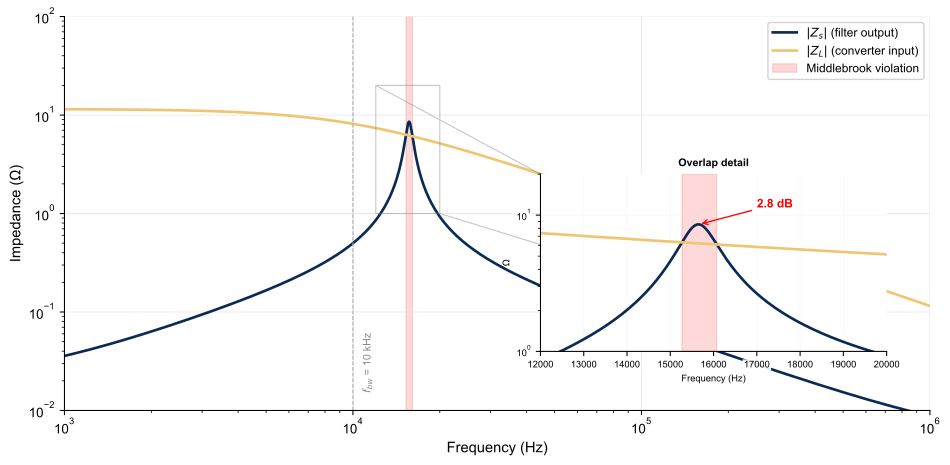
The filter resonance at 15.7kHz sits above the converter's 10kHz control bandwidth. At 15.7kHz, the converter's control loop can only partially respond to input perturbations, so the input impedance is in transition between its low-frequency negative resistance (-11.5Ω) and the passive impedance of the input stage. The magnitude of at the filter resonance has dropped to about 6.2Ω, while the filter's output impedance peaks to about 8.5Ω.
The impedance overlap is about 2.8dB. The minor loop gain peaks at 1.38 with a phase of -126° at 15.7kHz. The Nyquist trajectory swings down through the fourth quadrant, loops through the third quadrant, and returns through the second quadrant, passing within 0.14 units of the critical point (-1, 0) at 16.2kHz. It doesn't encircle it. The system is stable.
But the criteria disagree on whether that 0.14 margin is acceptable.
Middlebrook: the magnitude-only test
R.D. Middlebrook published "Input Filter Considerations in Design and Application of Switching Regulators" at the IEEE IAS Annual Meeting in 1976 [1]. The criterion requires:
Or equivalently, everywhere. The forbidden region in the Nyquist plane is everything outside the unit circle centred at the origin.
In our worked example, peaks at 1.38 (2.8dB) at the filter resonance. At = 15.7kHz:
Middlebrook fails. The source impedance exceeds the load impedance by 2.35Ω at the filter resonance.
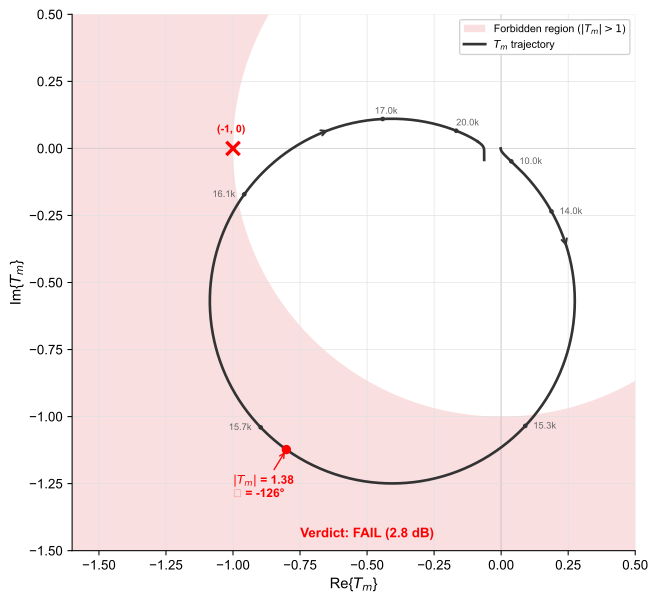
The criterion's strength is that it's simple. Plot the two impedance magnitudes on the same graph, if they don't cross, you're done. No phase measurement needed [8]. It also guarantees something stronger than just stability: it preserves the converter's original dynamic performance [1], [9]. The input filter doesn't change the loop gain, output impedance, or transient response at all.
The weakness is severe over-conservatism as it ignores phase entirely. A 3dB overlap with the phase of at 0° (positive real axis, far from instability) and a 3dB overlap with the phase at -180° (negative real axis, right through the instability point) are treated identically. One is perfectly safe, the other will oscillate. Middlebrook doesn't distinguish them.
GMPM: adding phase information
Wildrick, Lee, Cho, and Choi at Virginia Tech's CPES formalised the Gain Margin / Phase Margin (GMPM) criterion in 1995 [2]. Instead of requiring everywhere, GMPM applies classical gain margin and phase margin requirements to treated as a loop gain.
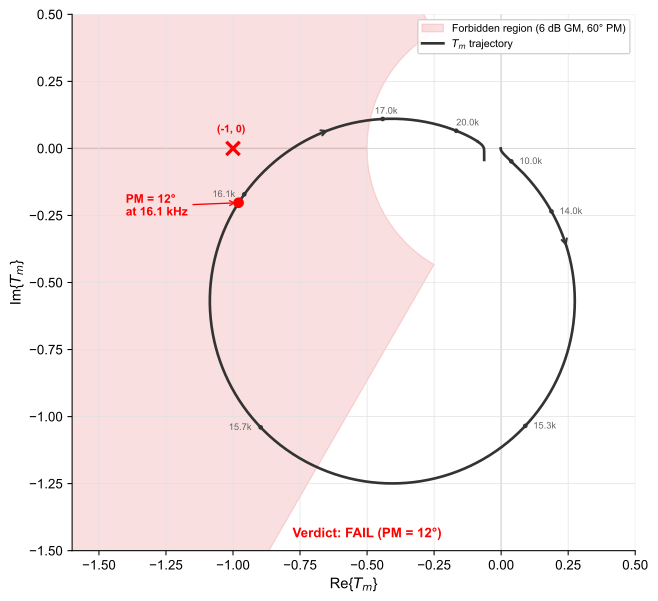
The forbidden region in the Nyquist plane becomes a wedge-minus-circle: smaller than Middlebrook's unit circle but still centred at the origin. Standard requirements are 6dB gain margin and 60° phase margin.
The gain margin check: at any frequency where the phase of crosses -180° (the negative real axis), is safely below unity?
The phase margin check: at the frequencies where crosses 0dB, how far is the phase from -180°?
In our worked example, crosses 0dB at two frequencies:
First crossing (15.3kHz): = -83°, so PM = 180° - 83° = 97°. The Nyquist point here is approximately (0.13, -0.99), in the fourth quadrant, well away from (-1, 0). No problem.
Second crossing (16.1kHz): = -168°, so PM = 180° - 168° = 12°. The Nyquist point is approximately (-0.98, -0.20), just below the negative real axis and very close to (-1, 0). This is the dangerous crossing.
The phase of never reaches -180° in this example (the trajectory crosses the real axis at 16.3kHz at Re = -0.78, to the right of the critical point), so the gain margin is technically infinite. But the 12° of phase margin at the second 0dB crossing means the trajectory is uncomfortably close to the instability point.
GMPM with 60° PM fails. Even with a relaxed 30° PM requirement, it still fails.
Opposing Argument criterion: constraining only the real part
The Opposing Argument criterion (Feng, Liu, and Lee, Virginia Tech, 2002 [3]) takes a different slice through the problem. Instead of tracking both magnitude and phase, it constrains only the real part of :
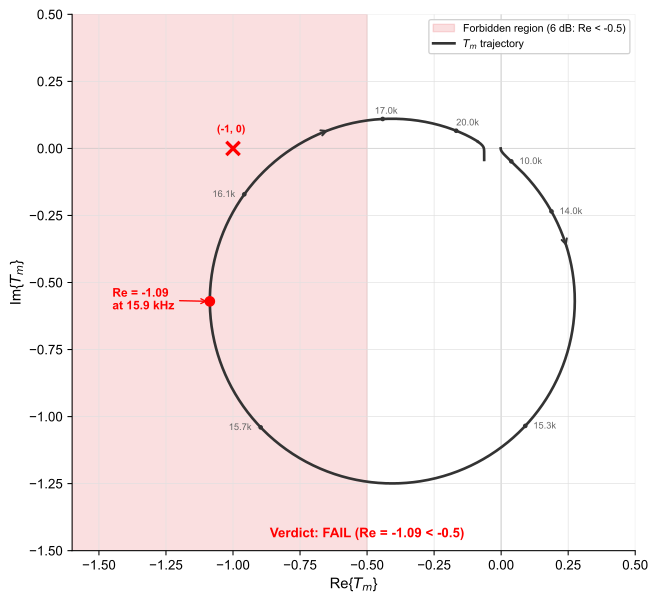
The forbidden region is a vertical half-plane to the left of a vertical line at . With 6dB gain margin, the boundary sits at .
In our worked example, the minimum value of is -1.09 at 15.9kHz. At this frequency:
The real part falls below -1.0 (the 0dB boundary), meaning the Nyquist trajectory crosses to the left of at this frequency. With the 6dB boundary at -0.5, the violation is even clearer.
This is interesting: the Opposing Argument criterion is supposed to be less conservative than GMPM, but for this particular trajectory it's actually more restrictive. The reason is the trajectory shape. The Nyquist plot passes close to the negative real axis at a steep angle, so the real-part constraint (a vertical line) bites harder than GMPM's wedge-shaped region at this angle of approach. Whether Opposing Argument or GMPM is tighter depends on the specific trajectory geometry, which is a point the theoretical conservatism hierarchy doesn't always make clear.
ESAC: partition-insensitive analysis
The ESAC criterion (Sudhoff, Glover, et al., Purdue, 2000 [4]) works in admittance space rather than the Nyquist plane used by the criteria above. It defines a forbidden region in the admittance plane whose shape is specifically designed to be insensitive to how components are partitioned between source and load [4], [6].
This is ESAC's main practical advantage. Unlike GMPM and Opposing Argument, ESAC gives the same stability conclusion regardless of where you draw the analysis interface. It also handles operating-point uncertainty natively: the forbidden region can be computed across multiple load conditions in a single analysis [4].
Because ESAC operates in admittance space, its forbidden region can't be drawn as a simple shape in the Nyquist plane. Fig. 5 shows the admittance plane directly, where the source and load admittances are plotted as and . Stability requires that maintains a positive real part with adequate margin — geometrically, this means the and curves stay separated.
For our worked example, the admittance curves maintain clear separation across all frequencies. The design passes.
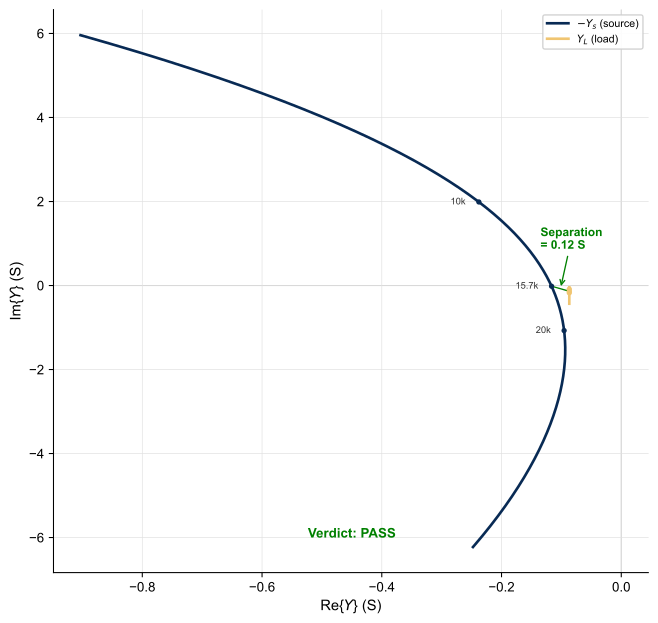
ESAC's partition insensitivity is worth emphasising. With GMPM, moving a capacitor from the "source" side to the "load" side of the analysis interface changes the calculated margins. ESAC gives the same answer regardless. For a single converter-plus-filter, this distinction rarely matters. For multi-converter systems on a shared bus, it's the difference between a trustworthy analysis and one that depends on an arbitrary modelling choice [4], [6].
Maximum Peak Criterion: centering on the critical point
The Maximum Peak Criterion (Vesti, Suntio, Oliver, Prieto, and Cobos, 2013 [5]) constrains the sensitivity function rather than directly:
The peak of over all frequencies, called , quantifies how close the Nyquist plot of gets to (-1, 0). The forbidden region is a disc of radius centred at (-1, 0), not at the origin. This is the least conservative circle-based criterion because it puts the exclusion zone exactly where it needs to be.
In our worked example, = 7.0. That's high. With a standard = 2.0 target, the design fails. Even = 5.0 fails. Only at = 8.0 does it pass.
The closest approach to (-1, 0) occurs at 16.2kHz, where = (-0.90, -0.10). The distance is:
And . The standard = 2 target requires , meaning the trajectory needs to stay at least 0.5 units from (-1, 0). We're at 0.14, roughly 3.5× too close.
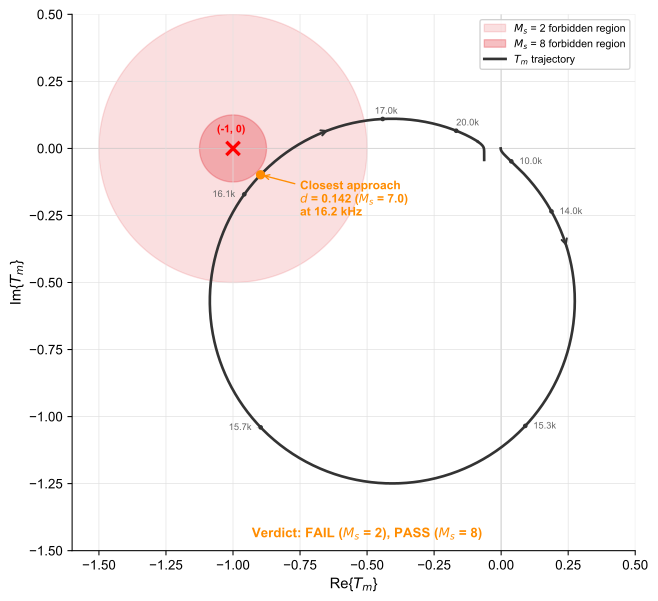
MPC gives a single scalar metric () that captures the combined effect of gain and phase margins at all frequencies [5]. This makes it useful for comparing competing architectures: compute for each, pick the one with the lower value.
PBSC: passivity as a stability guarantee
The Passivity-Based Stability Criterion (Riccobono and Santi, University of South Carolina, 2012 [7]) shifts the approach entirely. Instead of analysing the impedance ratio between source and load, PBSC requires that the overall bus impedance satisfies:
This simply means the bus must never source energy at any frequency. If every subsystem connected to a bus is individually passive, their parallel combination is automatically passive, and the system is guaranteed stable [7].
In our worked example, the bus impedance is . At 25kHz:
= 0.003Ω. The bus is technically passive, but with essentially zero margin. Any increase in the filter Q or load power would push it negative.
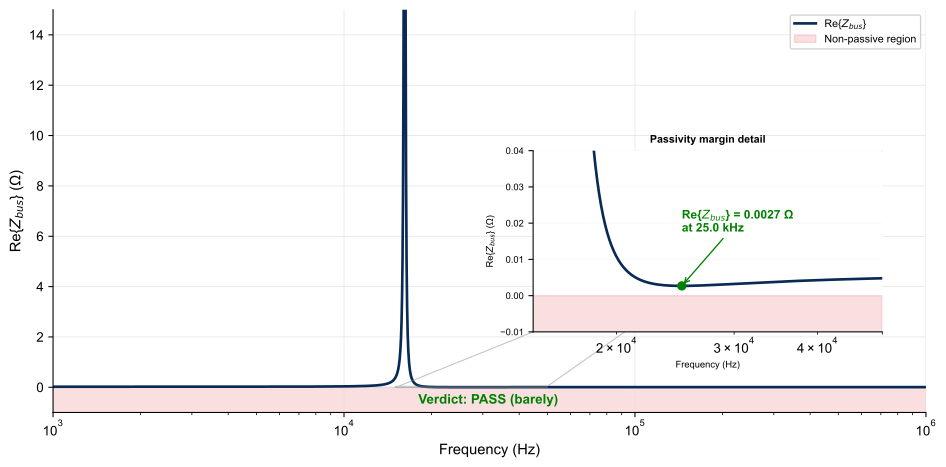
PBSC's main value isn't in single-converter analysis like this example. Its composability property matters for multi-converter systems [6], [7]: if each converter on a shared bus is individually passive, the assembled system is guaranteed stable without cross-checking impedance ratios between every pair of subsystems.
The limitation is that passivity is sufficient but not necessary for stability. A stable system doesn't have to be passive, enforcing it across all frequencies can be restrictive for some converter topologies, particularly those with digital control delays.
Full Nyquist analysis: the only exact answer
The full Nyquist criterion is necessary and sufficient [11]. It doesn't define a forbidden region beyond the single point (-1, 0). The system is stable if and only if the Nyquist plot of doesn't encircle that point.
In our worked example, the trajectory passes within 0.14 units of (-1, 0) but doesn't encircle it. To verify, we check where the Nyquist plot crosses the real axis:
16.3kHz: the trajectory crosses the real axis heading upward at . Since -0.78 > -1, this crossing is to the right of (-1, 0) and doesn't contribute an encirclement.
No crossings occur to the left of . Zero net encirclements. The system is stable.
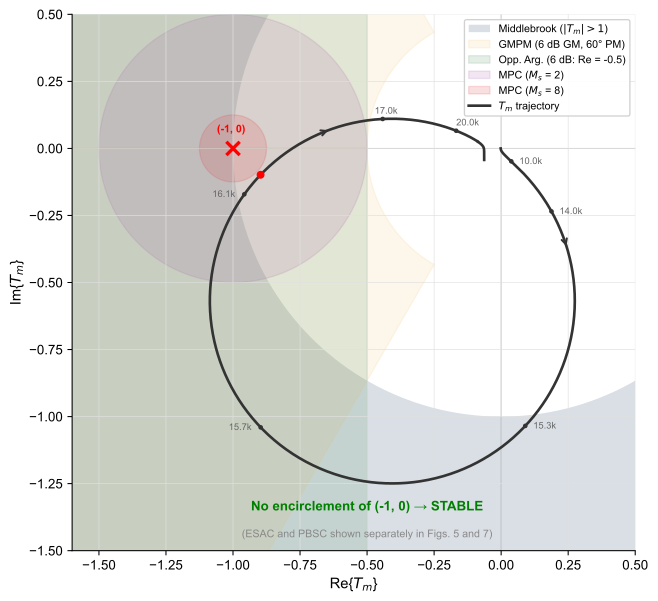
The Nyquist plot also tells you something none of the simplified criteria do which is where the system would oscillate if it did go unstable, and how much margin exists before that happens. The closest approach at 16.2kHz means that if the filter Q increased by roughly 15-20% (from temperature drift, cap ageing, or an inductor with tighter DCR tolerance), the trajectory would encircle (-1, 0) and the system would oscillate at approximately 16kHz.
That's thin margin. Whether 0.14 units is acceptable depends on your application. For a bench prototype with known, fixed components, it's fine. For a production design with component tolerances, temperature range, and ageing, you'd probably want more margin, which means some damping is justified. But the right amount of damping comes from targeting a specific value (say 2.0 or 3.0) based on your worst-case tolerance analysis, not from blindly doubling the filter capacitance because Middlebrook said so.
Two ways to fix it: capacitance vs. damping
If you decide the 0.14 margin isn't enough for production, there are two approaches: increase to shift the resonance and reduce , or add a parallel RC damper to reduce the filter Q directly. The two approaches have very different costs per criterion.
Increasing alone (no damper) shifts the filter resonance lower and reduces the characteristic impedance. But it doesn't add damping resistance, so the Q stays high and the trajectory shape remains similar. Different criteria need different amounts of extra capacitance:
Table 1. Minimum to satisfy each criterion (no RC damper, = 4.7µH fixed).
| Criterion | Minimum | Increase from 22µF |
|---|---|---|
| Nyquist (stable) | 18µF | Already passes |
| PBSC () | 21µF | Already passes |
| Middlebrook () | 28µF | +6µF (27%) |
| GMPM (PM > 60°) | 28µF | +6µF (27%) |
| MPC () | 30µF | +8µF (36%) |
| MPC () | 40µF | +18µF (82%) |
| Opposing Argument () | 47µF | +25µF (114%) |
| Middlebrook 6dB () | 48µF | +26µF (118%) |
| Middlebrook 10dB () | 70µF | +48µF (218%) |
The Middlebrook 0dB row () is the bare minimum: no impedance overlap, but no margin either. In practice, military and aerospace specifications require 6dB or 10dB of impedance separation [10], which pushes Middlebrook to 48µF or 70µF respectively. At 6dB margin, Middlebrook (48µF) is actually slightly more demanding than Opposing Argument (47µF), which is the expected conservatism hierarchy.
The Opposing Argument's high requirement relative to its position in the theoretical hierarchy is also worth noting. Its half-plane boundary is particularly sensitive to trajectories that pass close to the negative real axis at a steep angle, which this one does. A different trajectory shape could reverse the ranking.
Adding an RC damper (electrolytic capacitor in series with a resistor, placed across ) attacks the problem directly by reducing the filter Q at resonance. A 22µF aluminium electrolytic in series with 0.5Ω, connected across the existing 22µF ceramic :
Before damper → after damper:
| Metric | Before | After |
|---|---|---|
| peak | 1.38 | 0.14 |
| 7.0 | 1.12 | |
| Min | -1.09 | -0.11 |
| Closest approach to (-1, 0) | 0.14 | 0.89 |
| Filter Q | ~18 | ~2 |
Every criterion passes simultaneously. The electrolytic's own ESR (typically 50-100mΩ) combined with the series resistor adds 580mΩ of damping at the resonant frequency. At 15.7kHz, the damper branch impedance is about 0.74Ω, comparable to the ceramic's 0.46Ω, so the two branches share the resonant current and the peak impedance collapses.
The power dissipated in the damper is small. The input ripple voltage at the filter resonance is typically under 1V peak-to-peak, giving roughly 0.5-1W in the damping resistor.
If you need to fix an impedance interaction, an RC damper is almost always more efficient than adding capacitance. It targets the root cause (excessive Q) rather than brute-forcing the resonant frequency lower.
What each criterion says about the same design
Table 2. Stability criterion comparison for the worked example (48V-to-5V, 200W buck with 4.7µH / 22µF input filter, Q ≈ 18).
| Criterion | Verdict | Fix required | Forbidden region |
|---|---|---|---|
| Middlebrook [1] | FAIL (2.8dB) | : 22µF → 28µF, or RC damper | Unit circle at origin |
| Middlebrook 6dB [1] | FAIL | : 22µF → 48µF, or RC damper | Circle r=0.5 at origin |
| GMPM (6dB/60°) [2] | FAIL (PM = 12°) | : 22µF → 28µF, or RC damper | Wedge at origin |
| Opposing Argument (6dB) [3] | FAIL (Re = -1.09) | : 22µF → 47µF, or RC damper | Half-plane |
| ESAC [4] | PASS | None | Curved, partition-insensitive |
| MPC ( = 2) [5] | FAIL ( = 7.0) | : 22µF → 40µF, or RC damper | Disc at (-1, 0) |
| MPC ( = 8) [5] | PASS | None | Disc at (-1, 0) |
| PBSC [7] | PASS (marginal, Re{} = 0.003Ω) | None, but no margin | Passivity envelope |
| Full Nyquist [6] | STABLE | None, but margin is thin (0.14) | Point (-1, 0) only |
Middlebrook at 0dB, GMPM, Opposing Argument, and MPC ( = 2) all reject this design. At the 6dB margin level that practical Middlebrook designs actually target, the filter capacitance jumps to 48µF. ESAC, PBSC, and the full Nyquist analysis all confirm it's stable, though PBSC only barely. The difference between the most demanding fix (Middlebrook at 6dB: to 48µF) and the correct answer (no fix needed, or minor damping for production margin) is real board space, real cost, and real transient performance degradation.
When Middlebrook is still the right choice
After all of the above, you might conclude that Middlebrook is obsolete [8] but this would be short-sighted. There are situations where its conservatism is useful:
You don't have phase data. Middlebrook requires only impedance magnitude plots, which you can get from a network analyser with a single channel or estimate from component datasheets. GMPM, ESAC, and MPC all require a frequency response analyser with phase measurement [12]. For a quick first-pass check, Middlebrook is the right tool.
You're working in aerospace or defence. MIL-STD-704 and similar specifications often reference Middlebrook-style impedance ratios with specific dB margins [10]. Showing your customer that you pass Middlebrook with 10dB margin is simpler than explaining ESAC forbidden regions to a programme reviewer.
You want guaranteed dynamic preservation. Middlebrook doesn't just guarantee stability. It guarantees that the input filter doesn't change the converter's loop gain, output impedance, or transient response at all [1], [9]. The less conservative criteria allow the filter to interact with the converter dynamics. The system is stable, but the step load response might ring more than without the filter.
Your system changes after deployment. In a modular power system where loads are added or swapped in the field, the impedance at the bus changes unpredictably. Middlebrook's conservative margin provides a buffer against configurations you didn't test.
Which criterion should you use?
For most commercial DC-DC converter designs with a single input filter, GMPM with 6dB gain margin and 60° phase margin is the right starting point [2], [8]. It's well-understood, matches what a frequency response analyser gives you directly, and doesn't require specialised tooling.
Use Middlebrook for first-pass checks, military/aerospace compliance, or when you can't measure phase [1] and accept the extra capacitor.
Use ESAC when you're dealing with a system that operates across a wide load range or has significant parameter uncertainty [4]. It's the best choice when you need to prove stability across multiple operating points without running the analysis separately for each one.
Use MPC when you need a single scalar robustness metric to compare competing architectures [5]. Set based on how much component variation your production design will see. = 2 for tight tolerance, = 3 for moderate, rarely above 5.
Use PBSC when you're designing individual converters that will share a bus with other converters designed by other teams [7]. The composability guarantee is worth the effort of enforcing passivity.
Always verify with a full Nyquist analysis before committing to hardware on a critical design [6], [11]. It's the only criterion that tells you exactly how much margin you have and at what frequency the system would oscillate if it did go unstable.
Middlebrook's criterion in practice picks up from here. It measures source and load impedance at three real interfaces, shows what the plots look like for an actual converter, and works through what changes when several converters share a bus.
Part 2 takes the other half of the problem. This article asks whether a filter you already have is stable. That one asks what the filter should have been, and finds that your attenuation target fixes the LC product while your stability margin fixes the inductor on its own. If you want the numbers without the derivation, the input filter calculator sizes the filter and its damping network and reports the margins it achieved.
References
[1] R. D. Middlebrook, "Input filter considerations in design and application of switching regulators," in Proc. IEEE Ind. Appl. Soc. Annu. Meeting, 1976, pp. 366-382. [Online]. Available: https://ridleyengineering.com/images/pdf/Middlebrook1976BritishLibrary.pdf
[2] C. M. Wildrick, F. C. Lee, B. H. Cho, and B. Choi, "A method of defining the load impedance specification for a stable distributed power system," IEEE Trans. Power Electron., vol. 10, no. 3, pp. 280-285, May 1995.
[3] X. Feng, J. Liu, and F. C. Lee, "Impedance specifications for stable DC distributed power systems," IEEE Trans. Power Electron., vol. 17, no. 2, pp. 157-162, Mar. 2002.
[4] S. D. Sudhoff, S. F. Glover, P. T. Lamm, D. H. Schmucker, and D. E. Delisle, "Admittance space stability analysis of power electronic systems," IEEE Trans. Aerosp. Electron. Syst., vol. 36, no. 3, pp. 965-973, Jul. 2000.
[5] S. Vesti, T. Suntio, J. A. Oliver, R. Prieto, and J. A. Cobos, "Impedance-based stability and transient-performance assessment applying maximum peak criteria," IEEE Trans. Power Electron., vol. 28, no. 5, pp. 2099-2104, May 2013. [Online]. Available: https://oa.upm.es/29571/1/INVE_MEM_2013_146717.pdf
[6] A. Riccobono and E. Santi, "Comprehensive review of stability criteria for DC power distribution systems," IEEE Trans. Ind. Appl., vol. 50, no. 5, pp. 3525-3535, Sep. 2014. [Online]. Available (thesis): https://scholarcommons.sc.edu/etd/2414/
[7] A. Riccobono and E. Santi, "A novel passivity-based stability criterion (PBSC) for switching converter DC distribution systems," in Proc. IEEE Appl. Power Electron. Conf. Expo. (APEC), 2012, pp. 2560-2567.
[8] T. Hegarty, "The Engineer's Guide to EMI in DC-DC Converters, Part 10: Input Filter Interactions," Texas Instruments, 2019. [Online]. Available: https://premiermag.com/wp-content/uploads/2022/01/H2PToday1911_design_TexasInstruments_part10.pdf
[9] R. Tymerski, "Impedance interactions: an overview," Portland State University, ECE 446 Course Notes. [Online]. Available: http://web.cecs.pdx.edu/~tymerski/ece446/ece446_robustness.pdf
[10] SynQor, "Input system instability," Application Note Doc# 065-0000060. [Online]. Available: https://www.synqor.com/document-download?document=Input+System+Instability.pdf
[11] S. Chen, Y. Bu, and H. S. Chung, "Small-signal stability criteria in power electronics-dominated power systems: a comparative review," J. Mod. Power Syst. Clean Energy, 2024. [Online]. Available: https://ira.lib.polyu.edu.hk/bitstream/10397/108889/1/Chen_Small-signal_Stability_Criteria.pdf
[12] OMICRON Lab, "Output impedance for stability analysis," Application Note. [Online]. Available: https://www.omicron-lab.com/fileadmin/assets/Bode_100/ApplicationNotes/Output_Impedance/AppNote_OutputImpedance_Stability_V1.1.pdf